The long tail is where customer service really gets expensive
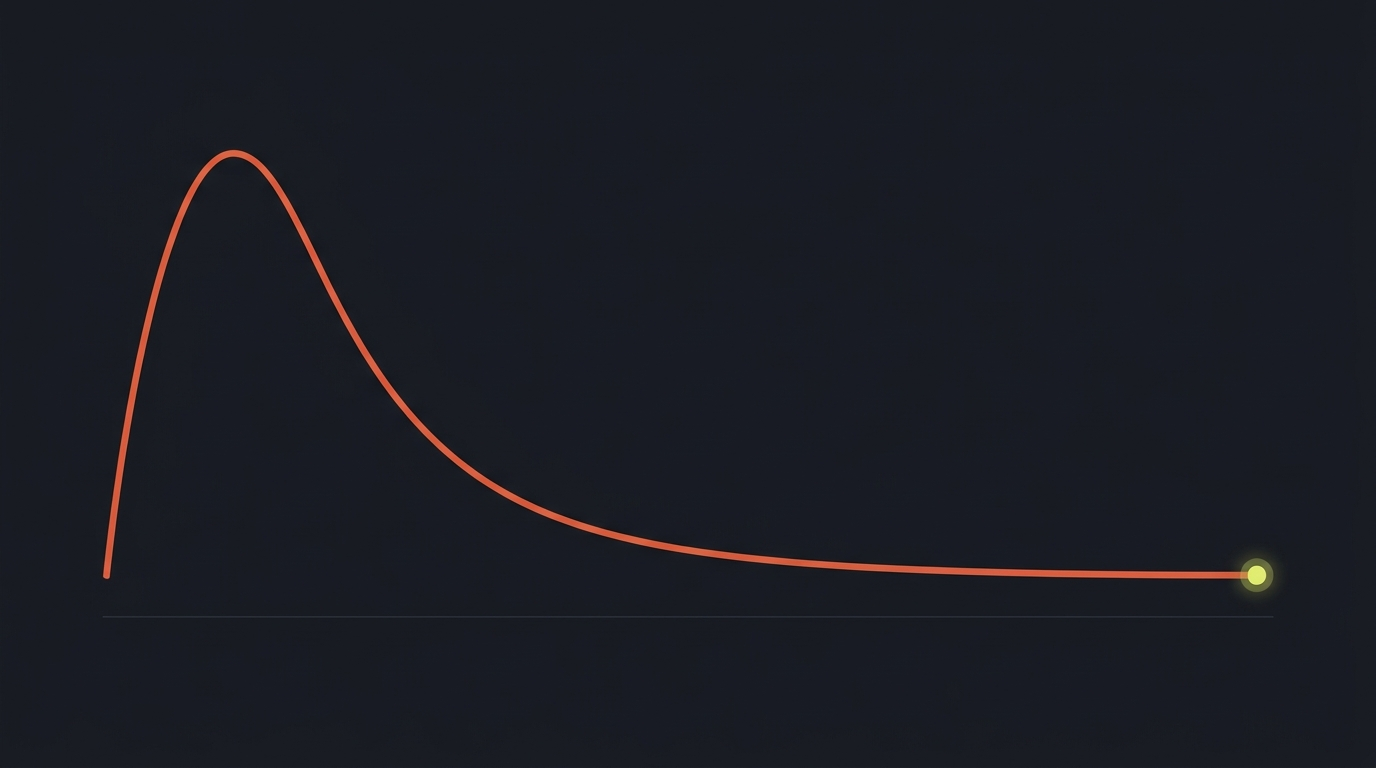
The routine is a solved problem. The long tail, the rare, tangled, frustrated cases, is where cost and brand damage concentrate. Here's how to surface it with the Atender MCP server and the Hard Stuff Hunter skill for Claude Cowork.
What you'll learn here: how to use the Atender MCP server together with our Hard Stuff Hunter skill, built for Claude Cowork, to surface the hardest cases hiding in your resolved conversations, read-only, in your own tools.
Point it at your tenant and ask in plain language. Here it is running in Claude Cowork over the last 30 days of resolved conversations.
Most support teams measure themselves on the middle of the curve. Average handle time, first-response time, deflection rate, CSAT. These numbers are dominated by the easy stuff: the password resets, the “where’s my order,” the questions your macros and your bots were built to answer. And on that part of the curve, the last few years have gone well. Automation has gotten genuinely good at the routine. The middle is handled.
But the middle was never the expensive part.
The expensive part is the long tail: the small percentage of conversations that don’t fit any template. A customer disputes an invoice line nobody can immediately explain. A problem turns out to have three sub-problems tangled together, half of which belong to another team. A perfectly reasonable request runs into an edge of your policy that no one wrote down. Someone comes back for the third time, and this time they’re not calm anymore.
These cases are rare. Individually they look like noise. But they carry a cost far out of proportion to their volume, and that cost shows up twice.
Two kinds of expensive
The first cost is the obvious one: time. A hard case doesn’t get resolved in one clean turn. It’s a drawn-out back-and-forth, a judgment call the agent has to reason their way to, a loop through two or three other people before anyone can even say what the right answer is. One of these conversations can burn more agent hours than fifty routine ones. If you add up where your handling time actually goes, a surprising amount of it is concentrated in a thin sliver of your ticket volume that no dashboard has a name for.
The second cost is quieter and, in the long run, larger: your brand. When a customer hits the hard tail, they are, almost by definition, having their worst experience with you. They’ve explained themselves more than once. They can feel that no template fits their situation. What they want isn’t a faster macro. It’s the sense that someone is actually listening, that a real person has understood their specific problem and is going to see it through. When that doesn’t happen, the damage isn’t a lower CSAT score on one ticket. It’s a customer who walks away convinced they can’t get through to you, and who tells other people so.
Here’s the trap: the better you get at automating the middle, the more concentrated your brand risk becomes in the tail. The routine cases that used to give agents easy wins and buffer their day are gone, handled by automation. What’s left in the human queue is disproportionately the hard stuff. The tail stops being a footnote and becomes the job.
The better you automate the middle, the more concentrated your brand risk becomes in the tail.
Where we think customer service is heading
Our view is simple. The future of customer service isn’t automating humans out of the conversation. It’s the opposite. It’s using AI to handle the routine so completely, and to surface the hard cases so precisely, that humans can spend their attention where it actually matters: being present, personal, and genuinely helpful on the cases that need a person.
The hard tail is where humans will always have the touch. A frustrated customer with a tangled, ambiguous problem doesn’t want to be deflected; they want to be heard. No model resolves that as well as a good agent who has the time and context to care. So the goal isn’t to replace that moment. It’s to find it, to pull the handful of genuinely hard conversations out of the thousands of routine ones, so your best people can be pointed straight at them.
That’s a different job for AI than the one everyone talks about. Not “answer the ticket.” Find the tickets that deserve a human.
Finding the hard stuff, inside your own tools
This is what we built the Hard Stuff Hunter to do. It works over your resolved conversations, the ones already closed, and answers a question your metrics can’t: which of these were actually hard, and what do they have in common?
The key idea is that difficulty isn’t a field you can filter on. It lives in the transcript, not in a column. A conversation that got handed to a human might have been trivial (“can I talk to a person?”). A six-message thread can be the hardest ticket of the week if it’s the third time someone’s asked and they’re now furious. So the Hard Stuff Hunter doesn’t just count metadata. It reads. It ranks your resolved conversations by cheap signals like repeat contacts and drawn-out threads, then reads the top of that ranking and scores each one on three things a person would recognize.
What comes back is a Long Tail Report: an honest, calibrated estimate of how much of your tail is genuinely hard, grouped into five to twelve named patterns, the recurring situations behind the difficulty. For each one, it tells you what made it hard, shows an anonymized example, and suggests a fix: a knowledge-base article waiting to be written, an automation worth building, or a brief for the team that actually owns the broken thing. Because a lot of hard cases aren’t a support problem at all. They’re a confusing invoice, a missing feature, a flow that breaks in one specific way. The tail is where your product tells you the truth.
And it runs where you already work. The Hard Stuff Hunter connects through Atender’s MCP server, so you point it at your own tenant, from your own tools, and get the analysis on your own data. It’s read-only by default: it reads conversations, it doesn’t touch them. It never publishes anything. If you want it to draft those KB articles, it will, but only when you explicitly ask, and only as drafts for you to review. Nothing goes live without you.
What is an MCP server?
MCP (Model Context Protocol) is an open standard that lets an AI agent connect securely to a system and use its tools. Atender’s MCP server exposes your workspace, conversations, contacts, and knowledge base, to agents like Claude, so they can read and act on your data with your permissions, and without a custom integration. We wrote more about it in Atender now speaks MCP.
The point
The routine is a solved problem, and it was never where the money or the goodwill was won and lost. The long tail is. It’s the most expensive part of your operation and the part your customers remember most. For years it’s been invisible, too rare to show up in the averages, too varied to file under one tag.
It doesn’t have to stay invisible. Let the AI find the hard stuff. Let your people do what only people can: help in the moments that need judgment, empathy, and ownership.